
Inside Access
JVIR
Interventional Oncology
IR Quarterly
Allaw S, Khabaz K, Yi Q, Ahmed O. Transarterial Embolization for Refractory Adhesive Capsulitis and Related Tendinopathies: A Systematic Review and Meta-Analysis. I Vasc Interv Radiol. 2025; 37.
Tell us about you, your team and your institution.
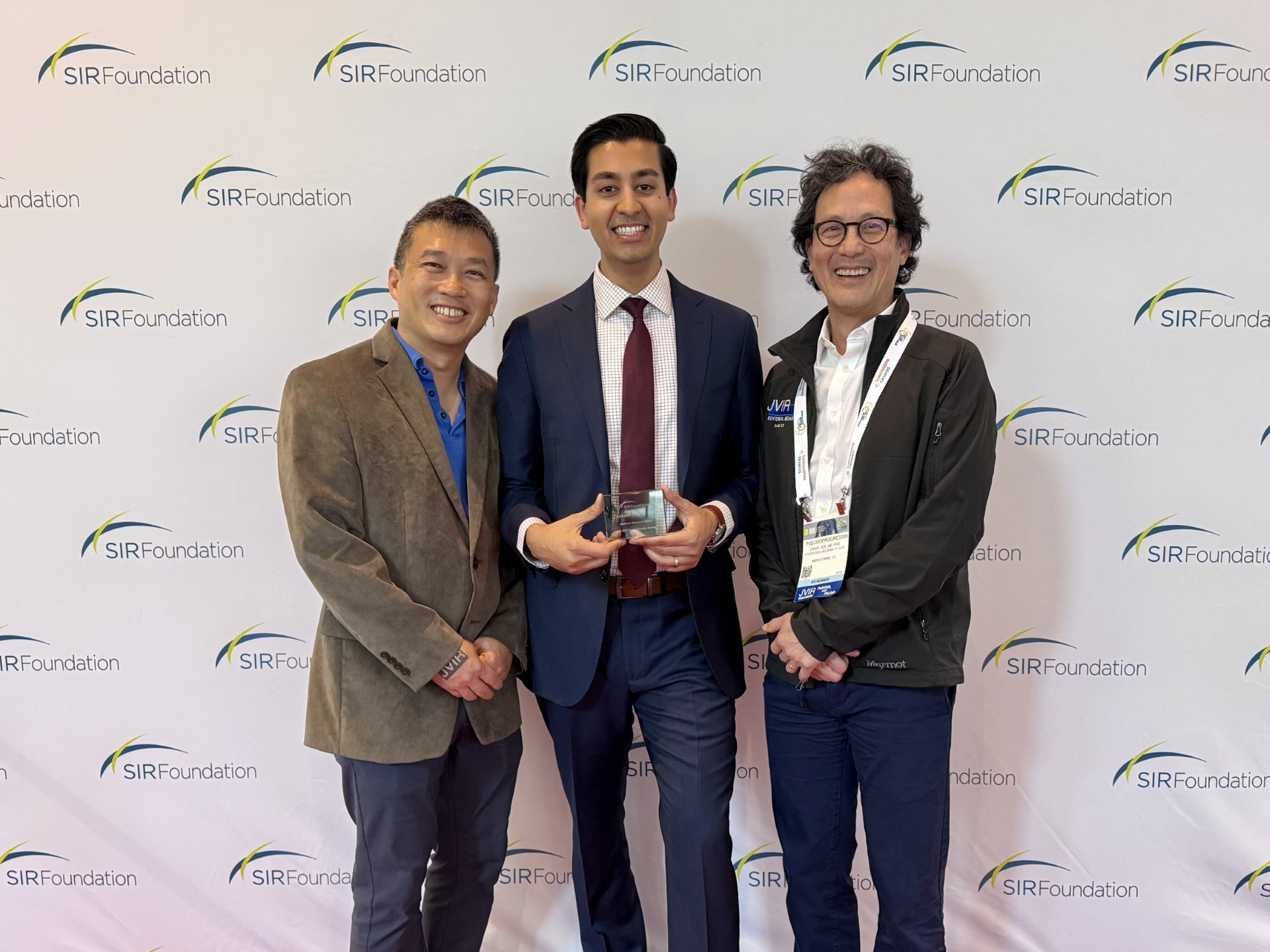
Kameel Khabaz and Sammy Allaw: We are a multi-institutional collaborative team. Kameel Khabaz is a medical student at the UCLA David Geffen School of Medicine, Sammy Allaw is a medical student at Indiana University School of Medicine, Qian Yu, MD, is a fellow at the University of Chicago Medicine, and our senior author, Osman Ahmed, MD, FSIR, is an interventional radiologist at the Joint and Vascular Institute.
This project grew out of a shared interest in musculoskeletal embolization and a recognition that the scattered evidence base for shoulder transarterial embolization (TAE) needed to be formally synthesized. Sammy and I led this project as co-first authors, with guidance from Drs. Yu and Ahmed.
Why did you pursue this topic?
Allaw and Khabaz: Adhesive capsulitis affects roughly 2–5% of the general population, and up to a third of patients don't get adequate relief from standard conservative therapies like physical therapy, NSAIDs and corticosteroid injections. Since Okuno and colleagues first described TAE for this indication back in 2013, a growing number of small cohort studies have been published, but the data remained fragmented across individual series with varying criteria and outcome measures. We felt there was a real need to unify existing studies to better understand the current evidence for TAE so that interventional radiologists could better counsel patients and so that the field could identify gaps in the current literature.


What are the key takeaways from your research?
Allaw and Khabaz: The central finding is that TAE produces large improvements in pain, shoulder range of motion and functional scores, with a favorable safety profile. Across 329 shoulders in 12 studies, pain scores dropped by more than 2.5 standard deviations by 3 months, external rotation improved by over 25 degrees, and ASES, a measure of shoulder function, increased by more than 38 points at the same timepoint. These improvements were sustained out to 6 months. On the safety side, there were 94 reported adverse events, of which 87 were mild per SIR guidelines. Only seven events (2.2%) were classified as moderate. No severe adverse events, permanent neurologic deficits or procedure-related readmissions were documented. That said, the evidence is limited by the absence of any controlled or randomized studies, and between-study heterogeneity was high, so these findings should be interpreted with caution.
How might this research influence treatment, practice or clinical processes in interventional radiology?
Allaw and Khabaz: We hope this meta-analysis provides interventional radiologists with a consolidated evidence base they can reference when discussing TAE with patients who have exhausted conservative management. The data suggest that TAE offers a minimally invasive, outpatient alternative to more invasive options like manipulation under anesthesia (MUA) or arthroscopic capsular release (ACR), procedures that carry higher risks and costs and have not demonstrated clear superiority over structured physiotherapy alone in head-to-head trials. Unlike MUA and ACR, TAE is performed under local or conscious sedation and is inherently organ-sparing. This work reinforces that the procedure is technically feasible with a favorable safety and efficacy profile, which should support informed shared decision-making.
How effective is TAE at reducing shoulder pain in patients with refractory adhesive capsulitis and tendinopathies?
Allaw and Khabaz: Very effective based on the available data. Because the included studies used different pain scales, we standardized the results to a common metric so they could be pooled together. What we found is that patients experienced significant pain relief as early as one month after the procedure, with continued improvement through three months, at which point the benefit appeared to remain stable out to six months. The magnitude of improvement was large and statistically significant across all timepoints. It's worth noting that between-study heterogeneity was high, which likely reflects the clinical diversity of the included populations, so these results should be interpreted in that context.
Does TAE improve shoulder mobility and functional scores (such as ROM and ASES), and how quickly are these improvements seen?
Allaw and Khabaz: Yes, and the trajectory of improvement is encouraging. For external rotation, the ROM metric with the most data available across all timepoints, the pooled mean change was about 12 degrees at one month, 26 degrees at three months, and 36 degrees at six months. These gains were statistically significant at each timepoint. ASES functional scores showed a similar pattern: a 23-point increase at one month, 38 points at three months, and nearly 59 points at six months. So unlike pain, which plateaus around 90 days, ROM and functional outcomes appear to continue improving through the six-month follow-up window. These findings are consistent across subgroup analyses for other ROM metrics including abduction, flexion, and active extension. Again, the between-study heterogeneity was high, so the results should be interpreted with caution.
What safety outcomes were reported across the included studies, and were any serious complications associated with TAE?
Allaw and Khabaz: The safety profile was favorable. Technical success was 100% across all 329 procedures in every study. Ninety-four patients, about 30%, reported some form of adverse event, but 87 of those were mild per SIR criteria: transient erythema, brief post-procedure pain flares, puncture-site hematoma, and itchiness. Only seven events (2.2%) were classified as moderate. Of those moderate events, two cases of skin ischemia were labeled as transient, two additional cases of skin ischemia resolved within one month, and one case of osteomedullary edema was no longer appreciated on follow-up MRI at six months. Two cases of worsening frozen shoulder symptoms reported by one study represented an exacerbation of pre-existing stiffness and pain that persisted at three months, without information provided about symptom resolution thereafter. No severe adverse events, permanent neurologic deficits, or procedure-related readmissions were documented in any study.
Any next steps or plans for follow up research?
Allaw and Khabaz: The most important next step for the field is well-designed randomized controlled trials. Our meta-analysis makes clear that while the signal for benefit is strong and consistent, every included study was a single-arm design with no control group, which fundamentally limits causal inference. Our risk of bias assessment underscored serious confounding and selection concerns in all but one study. Future research priorities include sham-controlled or head-to-head trials comparing TAE with alternative options. Extended follow-up beyond six months is also critical to ascertain any late adverse events and long-term durability. The field would also benefit from core outcome sets emphasizing objective ROM and validated functional instruments to reduce heterogeneity across studies. Finally, economic analyses will be important to inform broader adoption of TAE as a feasible treatment option.

Sammy Allaw

Kameel Khabaz
Related
-
IRQ Research
![]()
Inside Access: Iwan Paolucci, PhD
![]()
A new study investigating stereotactic thermal ablation of malignant liver tumors has found that the technology is likely to be safe, effective and reproducible in the U.S. healthcare system.
-
IRQ Research
![]()
Inside access: Masao Yamamoto-Ramos, MD, EBIR
![]()
Masao Yamamoto-Ramos, MD, EBIR, discusses how recognizing compensated venous phenotypes could support more personalized follow-up and treatment strategies in interventional radiology
Inside Access
Venous
-
IRQ Research
![]()
Inside access: Steve Landers MBBS
![]()
Inside the 6-month results of a prospective case series investigating transarterial embolization for plantar heel pain.
Inside Access
Pain Management
-
IRQ Research
![]()
How to get published in JVIR
![]()
Tips for standing out in a highly competitive submission pool
JVIR
IR research
-
IRQ Research
![]()
How to get started in research
![]()
A successful researcher doesn’t necessarily need a PhD—but they do need a varied support network, a strong plan and a commitment to persistence.
IR research
Research Funding: Awards
Research Funding: Grants
Women in IR
-
IRQ Research
Inside access: Aakash Gupta, MD
Dr. Aakash Gupta discusses TEPS as an effective last-resort option for portal decompression for specific patient populations.
JVIR
![]()
Related
![]()
-
IRQ Research
Inside Access: Iwan Paolucci, PhD
A new study investigating stereotactic thermal ablation of malignant liver tumors has found that the technology is likely to be safe, effective and reproducible in the U.S. healthcare system.
-
IRQ Research
Inside access: Masao Yamamoto-Ramos, MD, EBIR
Masao Yamamoto-Ramos, MD, EBIR, discusses how recognizing compensated venous phenotypes could support more personalized follow-up and treatment strategies in interventional radiology
Inside Access Venous -
IRQ Research
Inside access: Steve Landers MBBS
Inside the 6-month results of a prospective case series investigating transarterial embolization for plantar heel pain.
Inside Access Pain Management -
IRQ Research
How to get published in JVIR
Tips for standing out in a highly competitive submission pool
JVIR IR research -
IRQ Research
How to get started in research
A successful researcher doesn’t necessarily need a PhD—but they do need a varied support network, a strong plan and a commitment to persistence.
IR research Research Funding: Awards Research Funding: Grants Women in IR -
IRQ Research
Inside access: Aakash Gupta, MD
Dr. Aakash Gupta discusses TEPS as an effective last-resort option for portal decompression for specific patient populations.
JVIR
Related