IR residency pathways
Which IR residency route is right for you?
If you become an interventional radiologist, you’ll join the 2,000+ SIR trainee members worldwide considering or participating in these pathways. See your options below:


Integrated IR residency

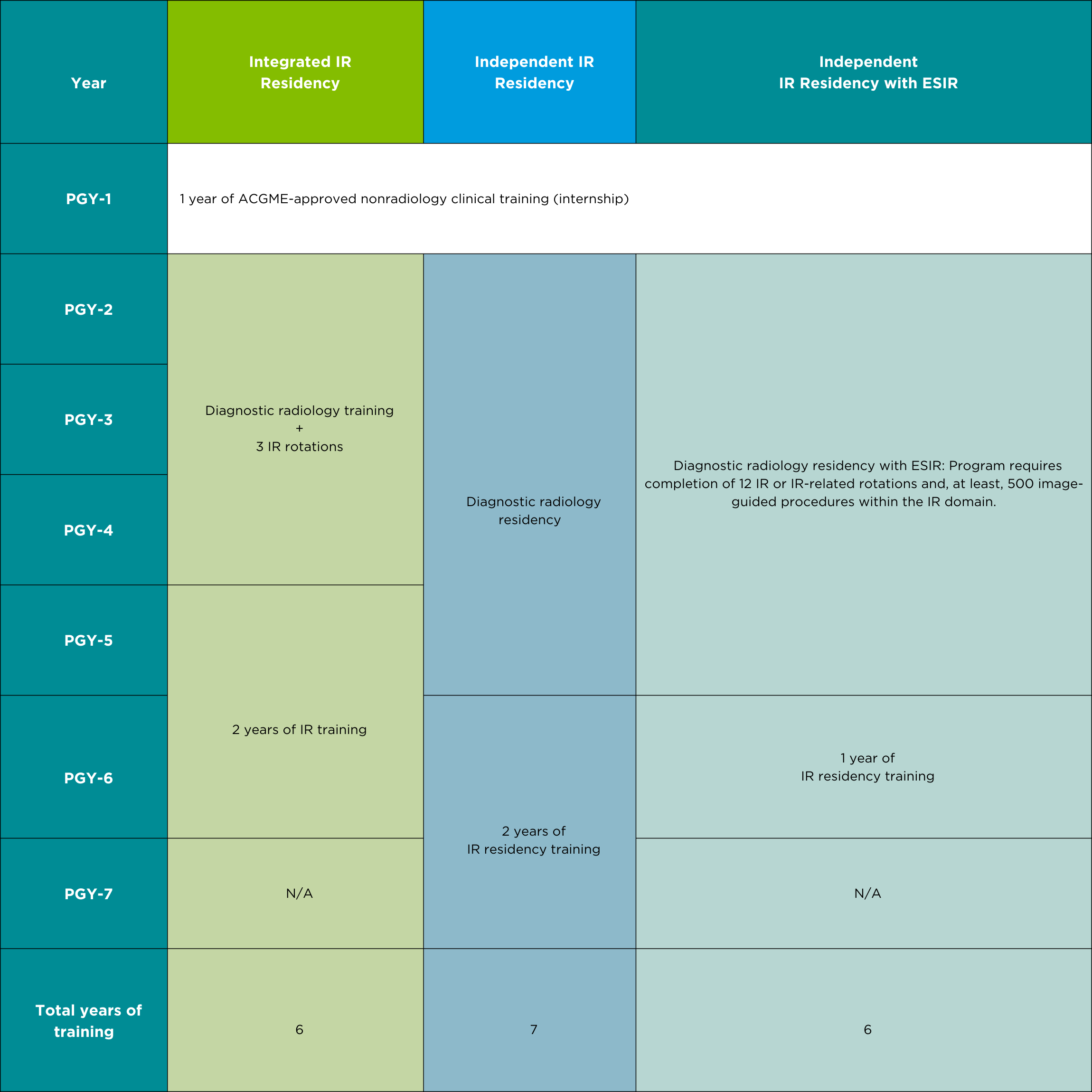
The integrated interventional radiology (IR) residency is 5 years in length (a total of 6 years of post-graduate training with the required internship year) and is available to medical students. The curriculum is concentrated on diagnostic radiology in the first three years and interventional radiology in the last 2 years.
- Program Year 1: One year of ACGME-approved nonradiology clinical training (internship)
- Program Years 2-4: Diagnostic radiology training and three IR rotations
- Program Years 5-6: Two years of IR training
Independent IR residency
The independent interventional radiology (IR) residency is 2 years in length (total of 7 years of postgraduate training) and is only available to graduates of a diagnostic radiology residency.
- Program Year 1: One year of ACGME-approved nonradiology clinical training (internship)
- Program Years 2-5: Diagnostic radiology residency
- Program Years 6-7: Two years of IR residency training


Independent IR residency with ESIR
Many diagnostic radiology residencies have an approved early specialization in interventional radiology designation, or ESIR. Diagnostic radiology residents who complete ESIR training may be able to finish their independent interventional radiology (IR) residency program in 1 year.
- Program Year 1: One year of ACGME-approved nonradiology clinical training (internship)
- Program Years 2-5: Diagnostic radiology residency with ESIR: Program requires completion of 12 IR or IR-related rotations and at least 500 image-guided procedures within the IR domain
- Program Year 6: One year of IR residency training
What trainees should know
Interventional radiology (IR) is evolving rapidly—and the way IR is practiced today may look very different in the future.
Geogy Vatakencherry, MD, FSIR, Interventional Radiology Program Director at Kaiser Permanente Los Angeles and Society of Interventional Radiology APDIR President (2026–2027), discusses how practice models in IR are changing and what trainees should understand as they prepare for their careers.
Dr. Vatakencherry explains how interventional radiologists are increasingly embracing clinic-based care, outpatient procedures and fully interventional practice models. He discusses:
Why the future of IR will involve more clinic and longitudinal patient care
How practice patterns are evolving across the field
The rise of 100% interventional practice models
The emergence of dedicated independent interventional practices
Why trainees should understand these trends as they plan their careers

Training pathways at a glance
View the yearly breakdown of the following IR residency programs:
- Integrated IR residency
- Independent IR residency
- Independent IR residency with ESIR